
People are changing how they discover brands, products, and services. Instead of relying only on Google, many consumers now use AI tools to compare options, ask questions, and get recommendations. At the same time, they continue using social platforms to research brands and see what real people are saying.
This is where AI search and social media are becoming closely connected.
Your social content may not only reach your followers. It can also help shape how your brand is understood across the wider online ecosystem. As AI search becomes a bigger part of the customer journey, brands need to think beyond traditional search rankings.
They need to become easier for both people and AI systems to understand.
What Is AI Search and Social Media?
AI search refers to the growing use of AI-powered tools to answer questions, compare brands, recommend products, and summarize information.
Instead of showing users a long list of search results, AI tools can provide a direct answer based on information they can access from different sources.
That changes the discovery process.
A potential customer might ask an AI tool:
“Which social media agency is best for growing an Instagram account?”
They might then ask:
“What should I look for in an organic social media agency?”
Finally, they could ask for specific recommendations.
The customer may already have a shortlist before visiting a company website.
As a result, AI search and social media should be considered part of the same broader discovery journey.
Why Social Media Matters for AI Discovery
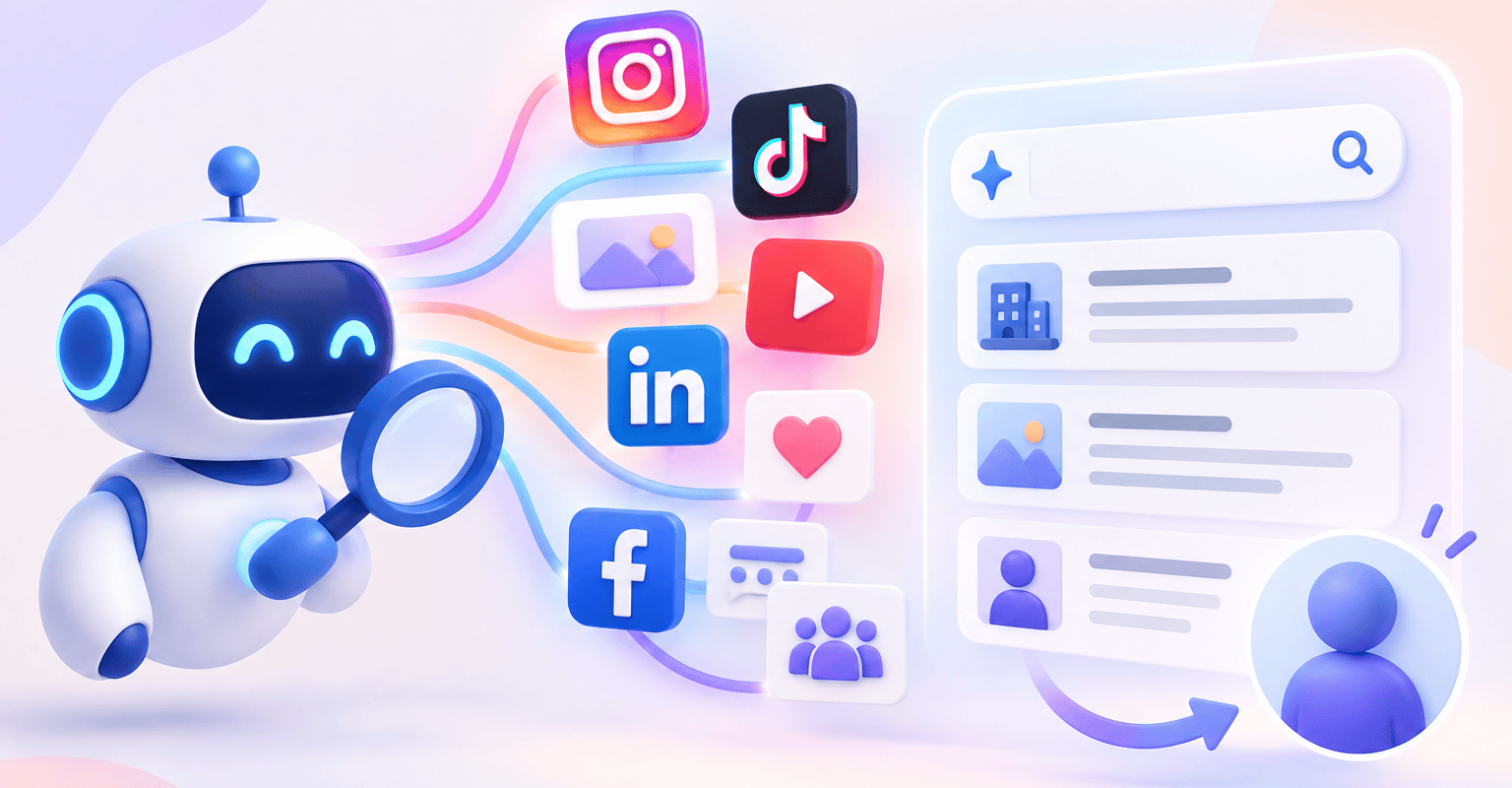
AI systems need information to understand brands.
That information can come from websites, publishers, reviews, communities, social platforms, and other sources. Current research around generative engine optimization shows that brands are increasingly competing for visibility inside AI-generated answers, not just traditional search results. :contentReference[oaicite:1]{index=1}
Social media can help provide context.
For example, a brand’s social presence can show:
- What the company does
- Who it serves
- What topics it knows well
- How it communicates
- What customers think
- What products or services it offers
- What makes the brand different
This is important because strong brand visibility is no longer only about publishing on your own website.
People are talking about brands in many places. AI systems can use information from this wider digital environment when forming answers and recommendations.
Create Content That Clearly Explains Your Brand
One of the simplest ways to improve your visibility is to make your content easier to understand.
Avoid vague posts that provide little context.
Instead, clearly explain what you do, who you help, and what problems you solve.
For example, instead of posting:
“We are helping businesses grow online.”
A stronger post could say:
“We help small businesses build consistent social media content and engagement strategies that attract more qualified customers.”
The second statement gives both people and search systems more useful information.
Therefore, make your key services, industries, expertise, and value proposition clear across your social profiles and content.
Consistency matters too.
Your website, LinkedIn profile, Instagram account, Facebook page, and other important channels should communicate the same basic brand information.
Focus on Useful, Specific Content
AI search and social media work best together when your content answers real questions.
Think about what your customers ask before they buy.
They may want to know:
- How much does the service cost?
- What should I look for when choosing a provider?
- Which solution is right for my business?
- What mistakes should I avoid?
- How long does the process take?
- What results can I realistically expect?
These questions can become social media posts, videos, carousels, articles, and FAQs.
For example, a marketing agency could create content around:
“5 signs your social media strategy needs a reset.”
A financial company could create:
“What should a small business track every month?”
A fitness brand could create:
“How do you choose the right workout plan for your goals?”
This approach gives your audience useful information while building topical relevance around the subjects your business wants to be known for.
Build Original Content, Not Just Generic AI Content
AI makes it easier than ever to produce content.
However, that also means generic content is becoming easier to ignore.
If hundreds of brands publish similar AI-generated posts, simply creating more content will not necessarily make your brand more visible.
Instead, add original information.
Share:
- Customer experiences
- Expert opinions
- Original data
- Case studies
- Examples from your work
- Behind-the-scenes insights
- Industry observations
- Lessons from real campaigns
- Unique perspectives
This gives your content something that generic posts often lack: evidence.
For example, instead of saying that “engagement is important,” explain what your team discovered after managing a campaign.
Instead of saying that “content consistency matters,” show how your publishing process works.
Specific experiences make your content more useful and more credible.
Encourage Customers and Creators to Talk About Your Brand
Your own social accounts are only one part of your online presence.
Other people talking about your brand can also contribute to your overall visibility.
That could include:
- Customer reviews
- Creator content
- Testimonials
- Community discussions
- Podcast appearances
- Industry articles
- Interviews
- Case studies
- Customer-generated content
This matters because consumers increasingly look beyond brand-owned content when researching companies.
In fact, current research on AI search highlights the importance of earned and third-party information in shaping brand visibility and consideration. :contentReference[oaicite:2]{index=2}
Therefore, your goal should not be to control every conversation.
Instead, build a brand that people have a reason to mention.
Optimize Your Social Profiles for Discovery
Your profile is another important part of AI search and social media visibility.
Make sure your profiles clearly communicate:
Who you are.
What you offer.
Who you help.
Where you operate, if location matters.
What makes your business different.
Use natural language that customers would actually use when describing your services.
For example, a profile that simply says “Marketing Expert” provides very little context.
A profile that says “Social media marketing agency helping small businesses grow through organic content and engagement” is much clearer.
Also, keep your descriptions consistent across important platforms.
The goal is simple: make it easy for someone to understand your business within a few seconds.
Think Beyond Traditional SEO
Traditional SEO is still important.
However, AI search introduces another layer of discovery.
Instead of asking only:
“How do we rank on Google?”
Brands should also ask:
“Would an AI system understand what our brand does?”
“Would customers describe us positively?”
“Are other credible sources talking about us?”
“Do we have useful content around our main areas of expertise?”
“Is our brand information consistent online?”
These questions help move your strategy from traditional search visibility toward broader digital visibility.
AI search and social media should therefore support the same goal: making your brand easier to discover, understand, and trust.
Measure Visibility, Not Just Traffic
AI search can make measurement more complicated.
A person might discover your brand through an AI recommendation without immediately clicking your website.
That means website traffic alone may not tell the whole story.
Start watching broader signals such as:
- Brand mentions
- Social conversations
- Branded searches
- Profile visits
- Content shares
- Customer questions
- Reviews
- Referral traffic
- Leads
- AI search visibility, where measurable
Most importantly, connect these signals to business outcomes.
A mention is useful, but a qualified lead is more valuable.
A high view count is encouraging, but a customer who discovers your business through your content is much more important.
What Brands Should Do Now
You do not need to completely rebuild your marketing strategy for AI search.
Instead, strengthen the foundation you already have.
Start by reviewing your social profiles and making your positioning clear.
Then, create content that answers customer questions and demonstrates real expertise.
Next, publish original insights instead of relying entirely on generic content.
After that, encourage customers, creators, and industry partners to talk about your brand.
Finally, make sure your website and social profiles tell a consistent story.
The brands that benefit from AI discovery will not necessarily be the brands that publish the most.
They will be the brands that are easy to understand, useful to their audiences, and consistently mentioned across trusted parts of the internet.
Final Thoughts
AI search is changing the way people discover and evaluate brands.
At the same time, social media is becoming more than a place to publish updates. It is becoming part of a wider discovery system where people research businesses, compare options, ask questions, and look for proof.
That is why AI search and social media should not be treated as completely separate strategies.
Your social content can help explain your expertise.
Your customers can provide proof.
Your creators can expand your reach.
Your website can provide deeper information.
Together, these signals can create a stronger digital presence that is easier for both people and AI systems to understand.
The goal is not simply to appear everywhere.
The goal is to become the brand people can find, understand, remember, and trust.


7 Responses
I especially like the focus on real experiences and original insights and I often play survival race
I like the point about making content useful and easy for people to discover. It is also interesting that interactive content can give people another reason to stay engaged instead of simply scrolling past it. I recently came across this browser game, and it was a fun little challenge to try during a short break.
Thanks for sharing this on AI Search and Social Media: Get Discovered in 2026. Clear and to the point. Posts like this are handy when I am bouncing between creative tasks. I often sketch a rough visual first with a browser-based AI image generator, then refine only the keepers.
If hundreds of brands publish similar AI-generated posts, simply creating more content will not necessarily make your brand more visible. Relive your childhood with doodle jump, the classic platform-jumping game that took the mobile world by storm. Your mission is simple: guide the Doodler as high as possible while dodging monsters and bottomless pits. Play now to unwind!
This makes meme PFPs especially useful because people can understand the tone of your account almost instantly. Some users prefer current memes because they want their profiles to reflect what is trending online, while others choose older reaction images because they have a timeless or nostalgic soul eater pfp. There is also a large category of intentionally outdated memes where the humor comes from the fact that the image is no longer considered fashionable.
This post insightfully highlights the evolving role of AI in enhancing social media discoverability. It’s fascinating to consider how these tools can democratize visibility for brands, much like gaming platforms such as Paper io encourage user engagement through strategy and creativity.
My sister runs a small flower shop, and customers now mention finding her through Instagram reels as often as Google searches. Last month, we tried asking an AI assistant for local florists and noticed her old business hours in one result. We even searched google phone number while figuring out how to reach support about the outdated listing, before finding the profile’s editing tools. After updating her hours and posting fresh bouquet photos, she received a call from someone who discovered her through an AI recommendation. It’s interesting how search, social media, and accurate business details all work together now.