
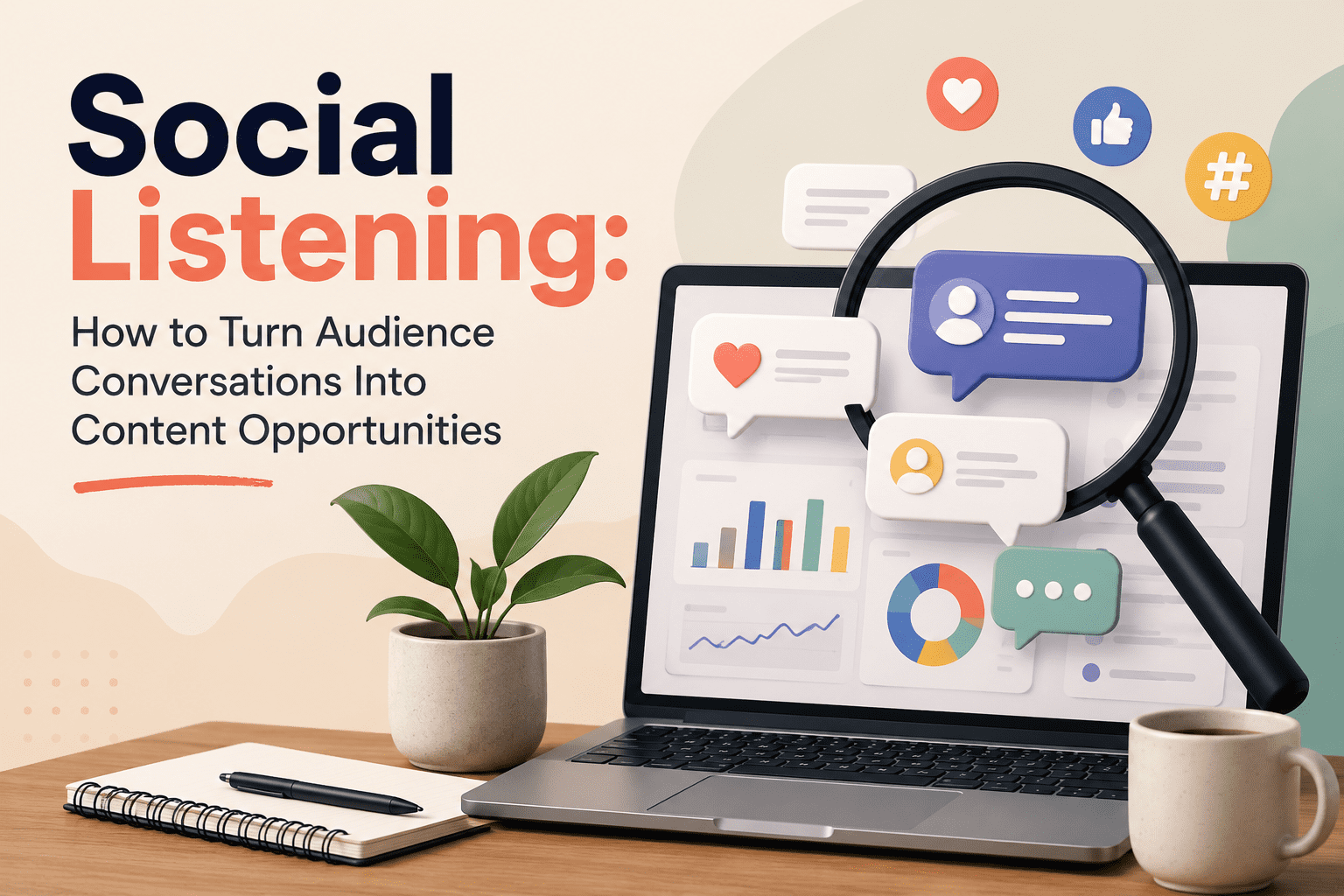
Social listening has become one of the most valuable tools for creators, brands, and businesses looking to better understand their audience. Every day, millions of conversations take place across social media platforms, providing insights that can help shape stronger content strategies and uncover new growth opportunities.
The challenge is knowing how to find those insights and turn them into meaningful opportunities.
This is where social listening comes in.
Social listening allows you to monitor conversations, identify emerging topics, understand audience sentiment, and uncover content ideas directly from the people you want to reach. Instead of guessing what your audience wants to see, social listening helps you create content based on real conversations and genuine interests.
In this guide, we’ll explore what social listening is, why it matters, and how you can use it to transform audience conversations into valuable content opportunities.
What Is Social Listening?

Social listening is the process of monitoring social media platforms, online communities, forums, and digital conversations to understand what people are saying about specific topics, industries, brands, or interests.
Unlike basic social media monitoring, which focuses primarily on mentions and notifications, social listening goes deeper by analyzing conversations and identifying patterns, trends, and audience sentiment. As conversations scale across dozens of channels, many brands turn to a social listening platform to bring these signals together in one dashboard rather than tracking them manually.
Social listening can help you discover:
- Common audience questions
- Industry trends
- Emerging topics
- Customer feedback
- Content gaps
- Pain points and challenges
- Frequently discussed products and services
These insights can serve as a valuable foundation for your content strategy.
Why Social Listening Matters
Many creators and brands spend hours brainstorming content ideas without realizing their audience is already telling them exactly what they want.
Social listening helps eliminate guesswork.
When you understand what your audience is discussing, you can:
- Create more relevant content
- Improve audience engagement
- Stay ahead of trends
- Build stronger community relationships
- Identify new opportunities for growth
- Better understand customer needs
Rather than creating content based on assumptions, you can create content based on real audience interests.
Understanding audience behavior is essential for effective content creation. Learn more in our guide on Social Media Analytics for Beginners.
Where to Find Audience Conversations
Audience conversations happen across multiple platforms and communities.
Some of the best places to practice social listening include:
Social Media Comments
Comments often reveal:
- Questions people are asking
- Opinions about specific topics
- Content requests
- Audience frustrations
Reviewing comments on your own posts and those of competitors can provide valuable insight into what people want to learn more about.
Community Groups
Online communities often contain highly engaged audiences discussing specific interests and challenges.
Examples include:
- Facebook Groups
- LinkedIn Groups
- Discord Communities
- Industry specific forums
These spaces often reveal recurring questions and trends that can inspire future content.
Reddit and Online Forums
Platforms like Reddit can provide unfiltered insights into audience interests.
People often discuss:
- Product experiences
- Industry challenges
- Recommendations
- Personal opinions
These conversations can help identify content topics that resonate with real users.
Search Queries
Search behavior is another form of audience conversation.
Pay attention to:
- Frequently searched questions
- Suggested searches
- Related search terms
- Common industry questions
These insights can help guide blog content, videos, and social media posts.
How to Turn Conversations Into Content Ideas
Collecting insights is only the first step. The real value comes from transforming those insights into content that serves your audience.
Look for Repeated Questions
When multiple people ask the same question, there is often a content opportunity.
For example:
If your audience frequently asks:
“How often should I post on Instagram?”
You could create:
- A blog article
- A carousel post
- A short video
- A downloadable guide
Repeated questions often indicate strong audience demand.
Identify Common Challenges
Pain points are some of the most valuable content opportunities.
Ask yourself:
- What frustrations appear repeatedly?
- What obstacles are people trying to overcome?
- What problems need solutions?
Content that helps solve problems is often highly engaging and shareable.
Monitor Industry Trends
Social listening can help identify trends before they become mainstream.
Pay attention to:
- New platform features
- Emerging content formats
- Industry conversations
- Audience behavior shifts
Creating content around relevant trends can help improve visibility and engagement.
Analyze Competitor Conversations
Your competitors’ audiences can provide valuable insights as well.
Review:
- Post comments
- Community discussions
- Frequently asked questions
- Popular content topics
This can help identify gaps in your own content strategy.
Once you identify audience interests, creating relevant content becomes much easier. Check out our article on How to Create Shareable Content That People Actually Want to Share.
Using Social Listening to Improve Content Performance
Social listening is not only useful for generating ideas. It can also help improve existing content.
By analyzing audience reactions, you can better understand:
- Which topics generate engagement
- What content formats perform best
- What messaging resonates most
- Which content gaps still exist
Over time, these insights can help refine your overall content strategy and improve performance across platforms.
Tools That Support Social Listening
While social listening can be done manually, several tools can make the process more efficient.
Popular options include:
- Google Alerts
- Brand24
- Sprout Social
- Hootsuite
- Mention
- BuzzSumo
These tools can help track conversations, identify trends, and monitor audience sentiment across multiple channels.
However, even simple manual observation can uncover valuable insights when done consistently.
Common Social Listening Mistakes
To get the most value from social listening, avoid these common mistakes:
- Focusing only on your own brand
- Ignoring audience sentiment
- Chasing every trend
- Collecting data without taking action
- Overlooking smaller communities
- Failing to track recurring themes
The goal is not simply to gather information but to use those insights to create better content and stronger audience connections.
The Future of Social Listening
As social platforms continue to evolve, social listening is becoming an increasingly important part of content strategy.
Artificial intelligence and advanced analytics tools are making it easier to identify trends, understand audience behavior, and predict emerging interests.
At the same time, audiences expect more relevant and personalized content than ever before.
Brands and creators who actively listen to their communities will be better positioned to create content that resonates and drives meaningful engagement.
Understanding audience conversations can also improve your overall content strategy. Read our guide on How to Use Data to Improve Your Social Media Strategy.
Final Thoughts
The best content ideas often come directly from your audience.
Social listening provides a practical way to understand what people care about, what challenges they face, and what conversations are shaping your industry.
Instead of relying solely on brainstorming sessions or assumptions, social listening allows you to create content based on real audience needs and interests.
By consistently paying attention to conversations across social media and online communities, you can uncover valuable content opportunities that help strengthen engagement, build trust, and support long term growth.
Ready to Turn Audience Insights Into Better Content?
Creating successful content starts with understanding your audience.
At Ampfluence, we help creators, brands, and businesses develop content strategies informed by real audience behavior, engagement trends, and social media insights.
Whether you’re looking to improve content performance, grow your online presence, or build stronger audience connections, social listening can provide the foundation for smarter content decisions.
Ready to create content your audience actually wants? Start listening to the conversations that matter.
Key Takeaways
- Social listening helps uncover valuable audience insights and content opportunities.
- Monitoring conversations can reduce guesswork in content creation.
- Audience questions often reveal high demand content topics.
- Social media comments, communities, forums, and search behavior provide valuable insights.
- Social listening can help identify trends before they become mainstream.
- Competitor conversations can reveal content gaps and opportunities.
- Understanding audience sentiment can improve content performance.
- Consistent social listening helps create more relevant and engaging content.
- The most effective content strategies are built around real audience interests and needs.



35 Responses
Great insights on social listening! I’ve found that tailoring content from audience feedback really boosts engagement. What tools do you recommend for analyzing these conversations effectively? 5 letter words
Great article on social listening! The point about mining audience conversations for content ideas is so practical. We use a similar approach at our platform — tracking what users search for in the AI image space has been invaluable for understanding demand patterns. The tools you mentioned for monitoring brand mentions are ones I have been meaning to try. Thanks for putting this together!
The article’s emphasis on turning social conversations into content ideas is spot on, especially given how many brands miss the signal in the noise. Would love to hear more about specific tools or techniques you’ve found effective for filtering relevant discussions from the chaos.
The article’s emphasis on turning audience conversations into content ideas is spot on. I’ve found that monitoring brand mentions and competitor hashtags reveals gaps in the market that traditional research often misses. Would love to hear more about which tools you recommend for real-time social listening.
Join in the exciting, physics-based action that makes every fight feel new and alive. Because of how ragdoll works, every meeting is different, which makes things even more exciting and surprising. Get ready for a crazy cartoon fight between stick figures that will test your skills and speed. Find out about the exciting world of Ragdoll Hit, the best fighting game with stick figures.
The article’s emphasis on finding insights in daily social media conversations really resonates—shifting from passive posting to active listening could be a game-changer for content strategy. I’m curious how much of that social listening should be automated versus manually reviewing discussions to capture genuine audience sentiment.
Great article on social listening. As a creator, I’ve found that monitoring audience conversations on social media really does uncover content ideas you’d otherwise miss. Would love to see more specific examples of tools or methods for turning those insights into actionable content strategies.
Great point about the challenge of filtering signal from noise in those millions of daily conversations. I’ve found that focusing on specific keywords related to audience pain points, rather than just brand mentions, really helps surface those actionable content ideas.
Great point about the sheer volume of daily conversations—it’s easy to overlook how much raw material is already out there for content ideas. I’ve found that tracking recurring questions in niche forums often reveals gaps that a quick blog post can fill.
Great point about the challenge of actually finding those insights—it’s easy to get overwhelmed by the sheer volume of conversations. I’ve found that focusing on recurring questions or complaints in my niche often reveals the most actionable content ideas.
The shift from just monitoring mentions to actually analyzing sentiment and intent is what makes social listening a game-changer for content strategy. Love how you emphasize turning those raw conversations into actionable ideas rather than just vanity metrics.
Social listening is a game-changer for moving beyond surface-level engagement metrics and actually mining the raw conversations for content direction. The key is filtering that noise to find the recurring questions or pain points your audience keeps circling back to.
It’s so true that the real challenge isn’t the volume of conversations, but knowing how to filter the noise and extract actionable insights. I’ve found that tracking recurring questions or complaints in comments often reveals the best content gaps to fill.
The point about turning everyday conversations into content ideas is spot on—I’ve found that monitoring recurring questions in my niche’s comments often sparks my best posts.
The point about millions of daily conversations being a goldmine for content ideas really hits home—I’ve found that just tracking recurring questions in my niche gives me a steady stream of blog topics.
It’s a great reminder that the real gold isn’t just in tracking mentions, but in catching the *unspoken* needs behind the conversations your audience is already having.
The point about millions of daily conversations being a goldmine for content ideas really hits home—I’ve found that tracking recurring questions in niche forums often reveals gaps my own posts can fill.
The point about turning daily social conversations into actionable content ideas is spot on—too many brands just monitor mentions without actually mining those discussions for new angles.
The point about millions of daily conversations being a goldmine for content ideas really resonates—it’s amazing how much untapped material is hiding in plain sight once you start actively listening instead of just broadcasting.
Great point about the challenge of filtering signal from noise in millions of daily conversations. I’ve found that tracking recurring questions in niche forums often reveals content gaps that standard keyword tools miss.
Love how this breaks down the gap between just monitoring mentions and actually turning those conversations into actionable content ideas. The point about uncovering growth opportunities through audience pain points is spot on.
Great point about the challenge of filtering signal from noise—it’s easy to get overwhelmed by the sheer volume of conversations, but the real value is in spotting those recurring pain points or questions that can directly fuel your next blog post or product idea.
Great point about the challenge of turning raw conversations into actionable insights—it’s easy to get overwhelmed by the noise, but focusing on recurring questions or pain points from your audience is a smart way to filter for content ideas.
The point about turning scattered social conversations into structured content ideas is spot on—I’ve found that tracking recurring questions in my niche often reveals gaps that a single blog post can fill.
The point about turning scattered conversations into a structured content pipeline is spot on—it’s the difference between guessing what your audience wants and actually hearing them ask for it. I’ve found that digging into the “why” behind a spike in mentions often reveals the exact angle for a post that would’ve flopped otherwise.
The “knowing how to find those insights” part is the real hurdle—it’s easy to get buried in volume, but the gold is in the niche questions people ask that your content isn’t answering yet. I’ve found that filtering for the *problems* mentioned in comments, rather than just the keywords, gives me a direct line to my next three post ideas.
The part about turning scattered conversations into a structured content strategy really hits home—I’ve found that the “why” behind a comment thread often sparks better ideas than the topic itself. Do you have a go-to method for filtering out the noise when you’re first starting with social listening?
I actually found the tip about tracking unfiltered Reddit threads for content gaps the most useful piece here, because that raw audience frustration is something I see constantly when researching game launch issues on this roadmap and platform guide, where players are far more blunt about what they really want than they ever are in official feedback surveys.
The part about turning scattered conversations into actual content ideas is where most people get stuck—it’s easy to see what’s trending, but harder to filter out the noise and find the questions your audience is really asking. I’ve found that digging into the “why” behind a spike in mentions often reveals a content gap you didn’t even know existed.
The shift from just tracking metrics to actually mining the language of those conversations is where the real gold is—it’s the difference between knowing *what* people are talking about and *why* they care. I’ve found that the most underrated content ideas come from the questions people ask in the comments, not just the trending hashtags. It’s a solid reminder that the audience is basically handing you the editorial calendar if you’re willing to listen.
The jump from “monitoring” to actually mining those conversations for content angles is where most people drop the ball—glad this breaks down how to close that gap. Curious if you prioritize engagement volume or sentiment shifts more when deciding which conversation threads are worth turning into a full piece.
The “turn conversations into content ideas” angle is the real gold here—it’s easy to get stuck tracking metrics, but using the *language* your audience already uses to shape your next post is a much smarter shortcut than guessing. I’ve found that mining the questions people ask in comments is basically a free editorial calendar.
The part about turning everyday conversations into actual content ideas is where most people get stuck—it’s easy to monitor mentions, but harder to spot the recurring questions that make great posts. I’ve found that digging into the “why” behind a spike in a certain topic reveals way more than just tracking volume.
The jump from “monitoring” to actually mining those conversations for content angles is where most people drop the ball—glad this breaks down the practical side of it. Curious if you prioritize certain platforms for listening depending on the content format you’re planning to create, or if a unified approach works better for you.
The part about turning scattered conversations into actual content ideas is where most people get stuck—it’s easy to monitor, hard to synthesize. I’d love to see a concrete example of how you filter out the noise and decide which conversation thread is worth building a full piece around.